Minimal Components
Active Control
Heat Exchange
Overview
The most basic HVAC you can build only truly requires three active (powered) components, but more typically nowadays has four:
Compressor
The Compressor, which does the “work” by compressing refrigerant and creating a pressure differential and is the most critical/necessary aspect of an HVAC system.
Outdoor Fan
The Outdoor Fan, which, in a typical AC unit will help condense the refrigerant in the Outdoor Coil by rejecting (expelling) heat to the outdoor air.
Indoor Blower
The Indoor Blower, which, in a typical AC unit will help evaporate the refrigerant in the Indoor Coil by absorbing heat from the indoor air (making that air cooler).
Metering Device
The Metering Device, which in very low cost units was a fixed orifice device and did not adjust during operation (was not active). Following that, the Thermal Expansion Valve (TXV) was more common, which used tuned fluid dynamics and pressure to adjust the Metering Device based on a target temperature. Finally, newer units use electronically controlled Electronic Expansion Valves (EEV or EXV), which require sensors and electronics to actively adjust the orifice.
Heat Exchangers
Both heat exchangers need to be sized appropriately to reject or absorb an appropriate amount of heat, but controlling the magnitude of this effect comes primarily from the Blower and Fan components.
How they work together
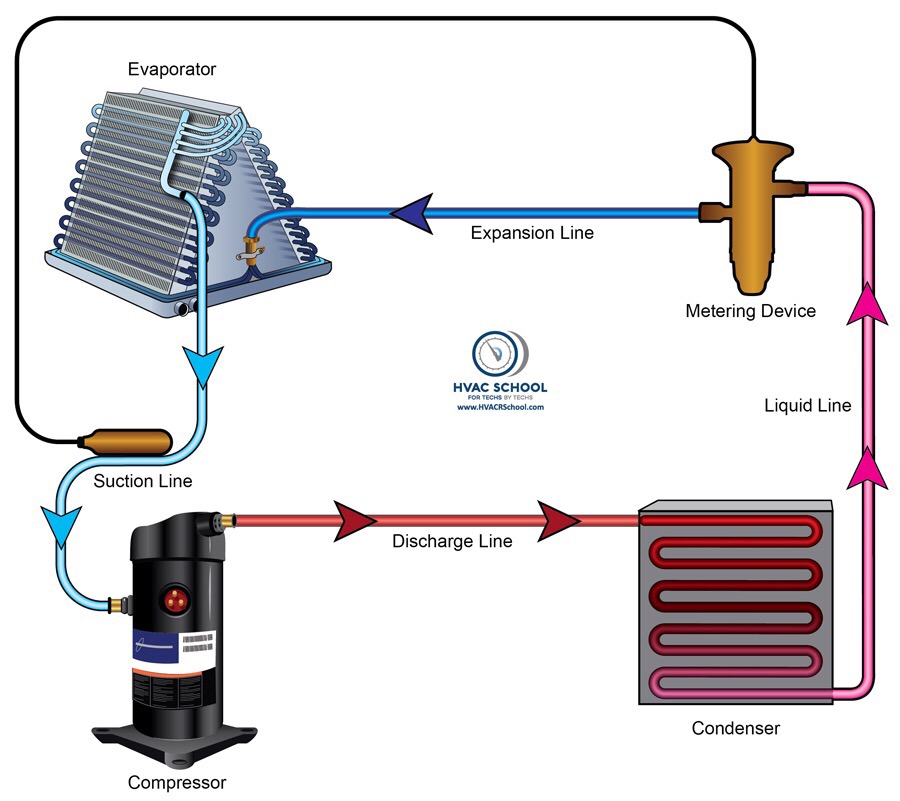
As noted in HVACR School’s Refrigerant Cycle Basics, the organization of these active components is as follows:
Compressor => Condenser => Metering => Evaporator => Compressor...
Adding in the piping to that flow gives you:
Compressor => Discharge Line => Condensor => Liquid Line => Metering Device => Expansion Line => Evaporator => Suction Line => Compressor...
High-side components (After compression, when refrigerant is high pressure)
Compressor => Discharge Line => Condensor => Liquid Line
Low-side components (After the Metering Device, when refrigerant is low pressure)
Metering Device => Expansion Line => Evaporator => Suction Line
Making a basic system work better
Accumulator
The Accumulator collects refrigerant before the compressor, it ensures there is only gas refrigerant getting to the compressor since liquids are not compressible and can damage the compressor. I addition, some refrigerant, if it is liquid, can boil off in the accumulator to become gas before the compressor.
Discharge Muffler
The Discharge Muffler, as the name implies “muffles” the shocks and vibrations of the refrigerant coming from the compressor. This can help keep the refrigerant circuit more stable in it’s operation.
Not wasting the rejected heat
Desuperheater
The Desuperheater or Hot Gas Reheat is an additional component that is not required, but will help “use” heat from the superheated refrigerant after the compressor for heating something else. For example, using that extra heat to help your boiler heat up water, instead of rejecting it all outside with no value. Another use, as noted in the name “Reheat” can be for dehumidification. In this instance, your HVAC is cooling when it typically doesn’t need to, specifically to condense water out of the air and reduce it’s relative humidity. If you don’t want to cool, the Hot Gas Reheat can “reheat” the air after condensation and before it is returned inside, so that the cooling effect is minimized.
Next Steps
With these details noted what is “necessary” to build an HVAC system?
Baseline System
The most basic system only uses relays to provide power to your Compressor, Fan and Blower, this system can rely on either a fixed orifice Metering Device or a TXV, which can optimize it’s efficiency.
Required Components
- Compressor
- Fan
- Blower
- Metering Device (Fixed Orifice at least)
- Liquid-Air Indoor Coils
- Liquid-Air Outdoor Coils
Suggested Components
- TXV
- Suction Accumulator
- Discharge Muffler
Tradeoffs
- Simplest unit design
- Requires “wide” operating ranges or extra hardware to avoid damaging equipment
- Adding a TXV can help narrow operating region
- Adding a muffler can reduce “shocks” to the system when turning the compressor on/off and based on the compressor type
- Adding an accumulator can allow prevent liquid refrigerant from entering the compressor, in case the Metering Device is insufficient or not fast enough
- A Thermostat in the home is required to basically “run” the system (turn on compressors and fan relays etc)
Inputs for Control
Switch Sensing
One of the most basic aspects of system control is sensing a “boolean” or on/off Switch value. This isn’t strictly a digital DC value, but can also be the detection of AC voltage signals passed through closed switches. Common scenarios where these are used are in sensing protection relays (High Discharge Pressure Switch) or Thermostat Controls signals (G, W, Y etc).
Temperature Sensor
Similar to adding the TXV, each aspect of the above system can be improved by adjusting it’s control during operation. Applying these dynamic systems each requires additional information so that it can be controlled correctly. Unlike with the TXV, which can regulate itself, other interfaces typically need some additional sensing and electronic controls to utilize. The first most valuable thing to add is a Thermistor, which can you can protect the unit against damage from temperatures that are out of spec high or low for the mechanical components. Second, like with the TXV, the temperature can be used to help regulate the Metering Device. In a basic system this can work similar to a TXV, where only the temperature affects the orifice size, but this can be improved with the addition of a Pressure sensor to determine the Suction Superheat Temperature. Without pressure you can still respond more quickly to changes in the system or adjust operation as desired, but you will still need a wider tolerance for the valve to work without risking damage. Temperature Sensors can also help control the fans in the system to optimize heat exchanger functionality.
Pressure Sensor
Similar to the temperature measurement, pressure can be used to protect equipment, ensuring the pressures in the refrigerant never exceed design limits. In addition, as noted in the temperature section, reading of the suction pressure can be used to determine the Saturated Suction Temperature and thus the Suction Superheat Temperature. Pressure can also be critical in determining the efficacy of air flow. That could relate to detecting clogged filters/coils, or adjusting airflow based on closed/open supply vents vents in the home.
Humidity Sensor
Humidity Sensors are obviously useful for controlling the humidity of the indoor airspace. Running HVAC in cooling mode will condense water from the air (if the coil is cold enough) and reduce humidity in the conditioned space. If you don’t want it cooler, you can add a heater or use a reheater to offset the cooling effect. Beyond direct humidity control, the level of humidity in the air can impact the perceived air temperature. Knowing the humidity indoors and out might help with determine whether to run an ERV to mix-in outdoor air.
Air Quality Sensor
Air Quality is a broad concept, as there are many different measures that can contribute to “good” or “bad” air quality. Some measures that contribute to air quality are:
- CO2 (Carbon Dioxide) Levels
- CO (Carbon Monoxide) Levels
- PM2.5 (Particulate Matter under 2.5 micrometers)
- PM10 (Particulate Matter under 2.5 micrometers)
- O3 (Ozone)
- SiO2 (Sulfur Dioxide)
- NO2 (Nitrogen Dioxide)
Airflow
Airflow goes hand in hand with pressure, and pressure can even be used as a passive way to determine airflow. Poor airflow can result in a pressure build up or reduction (depending where pressure is measured).
Generic Control Signals (0-10v, 4-20mA)
Commonly used control signals in industrial equipment will emit either a 0-10v signal or 4-20mA current drive. These signals are used for a whole bunch of purposes so there isn’t one particular application. These signals once read, will be converted based on a specification for signal scale.
Outputs for Control
Binary Control Signals
Relays are the most common target for control, in the most basic systems these are used to turn on fans and compressors, or open and close valving. These signals allow translation between lower voltage signals found on the PCB and higher voltages required by the electrical equipment.
Variable Control
PWM Control, 0-10v and 4-20mA control is most commonly used for variable speed components. This is typically used with compressors and fans, but can be used as a control signal for any other component.
Stepper Motor Control
A Stepper Motor control is most commonly used for Expansion Valve operation. It can be used for other purposes where an accurate motor is necessary, but this is the most common use. Another use might be in Liquid Valves or Dampers that require more accurate control (although I don’t know of cases of this being used).
Communication Protocols
As opposed to Input vs Output, or limited controls, using a Communication Protocol and appropriate hardware layer such as UART, I2C, SPI, RS-485, Modbus and others. These allow adding multiple devices onto a bus, and sharing input, output and configuration data.